
The Discipline of Today
There is a subtle trap most men fall into without realizing it. It doesn’t begin with failure. It begins with drift. They replay yesterday. They rehearse tomorrow. And they neglect today. Yesterday becomes regret. Tomorrow becomes anxiety. Today becomes avoidance. And avoidance rarely feels dramatic. It feels justified.
You tell yourself you’re thinking things through. You tell yourself you’re planning carefully. You tell yourself you just need clarity. But clarity does not come from mental repetition. It comes from disciplined execution.
Today is the only place anything real can be built. Not in memory. Not in projection. Not in imagination. You cannot rewrite what has already happened. You cannot control what hasn’t arrived. You can only decide what you do with the hours in front of you.
And that is either terrifying… or empowering. Terrifying, because it removes excuses. Empowering, because it restores agency. Most men fear the present because the present demands action. The past can be analyzed. The future can be fantasized. But today must be lived.
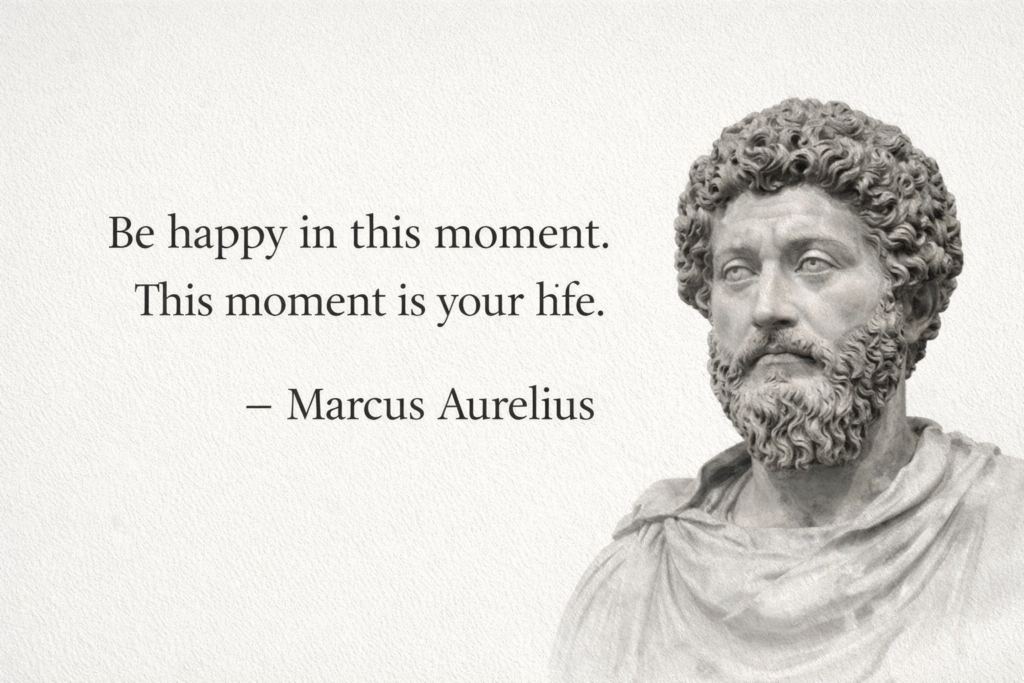
The Weight of Yesterday
Regret feels productive. It feels reflective. It feels responsible. It feels mature. But most of the time, it’s disguised paralysis. You revisit conversations. You rethink decisions. You replay mistakes. You mentally edit outcomes that no longer exist. You tell yourself you’re “processing.” But processing without movement becomes erosion.
There is a difference between learning from the past and living inside it. Psychologists call it rumination – repetitive negative thinking that strengthens emotional distress rather than solving problems. Study after study has shown that rumination increases anxiety, reinforces depressive thinking patterns, and reduces effective problem-solving. It creates the illusion of work without the reality of productivity.
The brain strengthens what it rehearses.
Neural pathways form through repetition.
If you rehearse failure long enough, it becomes identity.
“I made a mistake” becomes
“I am someone who always messes up.”
That shift is subtle.
But it is destructive.
Yesterday is data. Nothing more.
It is feedback.
It is instruction.
It is information.
It is not a prison sentence – unless you keep volunteering for confinement.
The disciplined man does not deny his past.
He extracts the lesson.
He adjusts the standard.
He moves forward.
He refuses to let a previous version of himself become a permanent definition.
Because you cannot build a future while constantly re-litigating the past.
The Illusion of Tomorrow
Planning feels powerful. It gives you a sense of control. You map it out. You imagine the version of yourself who has it handled. You rehearse the speech you’ll give. You picture the body you’ll build. You visualize the career shift. “I’ll start next week.” “When things settle down.” “When I feel ready.” Tomorrow is where discipline goes to die. Because tomorrow never demands action. Today does.
There is something seductive about postponement. Behavioral science calls it temporal discounting – the tendency to value future intention more highly than present effort. We overestimate what we will do later and underestimate the resistance we will feel when the moment actually arrives.
The mind loves tomorrow because tomorrow is painless.
There is no friction in imagination.
No discomfort in projection.
No accountability in hypotheticals.
But legacy is not built in hypotheticals.
The men who change their lives are not the ones who imagine a different future.
They are the ones who execute differently in the present.
They don’t wait for clarity.
They create it through repetition.
The Discipline of Presence
Living in today does not mean ignoring the future. It means building for it. Presence is not recklessness. It is alignment. You don’t obsess over the mountain. You lift today’s weight. You don’t fix your entire life in one decision. You correct one behavior. You don’t repair every relationship at once. You start with one honest conversation. You don’t build wealth in a weekend. You increase value today.
Presence is not passive. It is deliberate. It is controlled attention directed toward what can be influenced now. Neuroscience supports this. When attention is anchored in present, controllable action, stress decreases and performance improves. Anxiety rises when attention shifts toward uncertain future outcomes.
The brain thrives on execution, not speculation. Presence does not mean you shrink your ambition. It means you respect the process. You do not conquer tomorrow. You construct it. And construction happens one disciplined action at a time.

When Everything Feels Uncertain
There will be seasons where:
• The job feels unstable.
• Relationships feel unclear.
• Opportunities feel distant.
• Progress feels slow.
Uncertainty does not announce itself loudly. It shows up as restlessness. As doubt. As comparison. As subtle frustration. This is when today matters most. Not because today fixes everything. But because today keeps you aligned.
When life feels unstable, men chase momentum. They try to force acceleration. They overcorrect. They grasp for visible progress. But momentum is fragile. It rises quickly. It collapses just as fast.
Alignment is more powerful. Alignment is internal.
It is the decision to act in accordance with your standards – regardless of external turbulence.
Momentum can be lost.
Alignment rebuilds it.
And alignment is chosen daily.
he Quiet Power of Small Execution
You do not become disciplined in one grand act. You become disciplined in small, repeatable choices. Wake up when you said you would. Train even when motivation dips. Finish what you start. Say what you mean. Keep the promise you made to yourself. None of these are dramatic. None of them will trend. But they compound.
Each action is a vote for the man you are becoming. Identity is not declared. It is reinforced. Neuroscience shows that repeated behaviors strengthen neural pathways. The brain adapts to what it practices. Discipline, then, is not a personality trait. It is trained repetition. The future is not built in emotion. It is built in repetition. Emotion fluctuates. Repetition accumulates. The disciplined man does not wait to feel ready. He practices being ready.
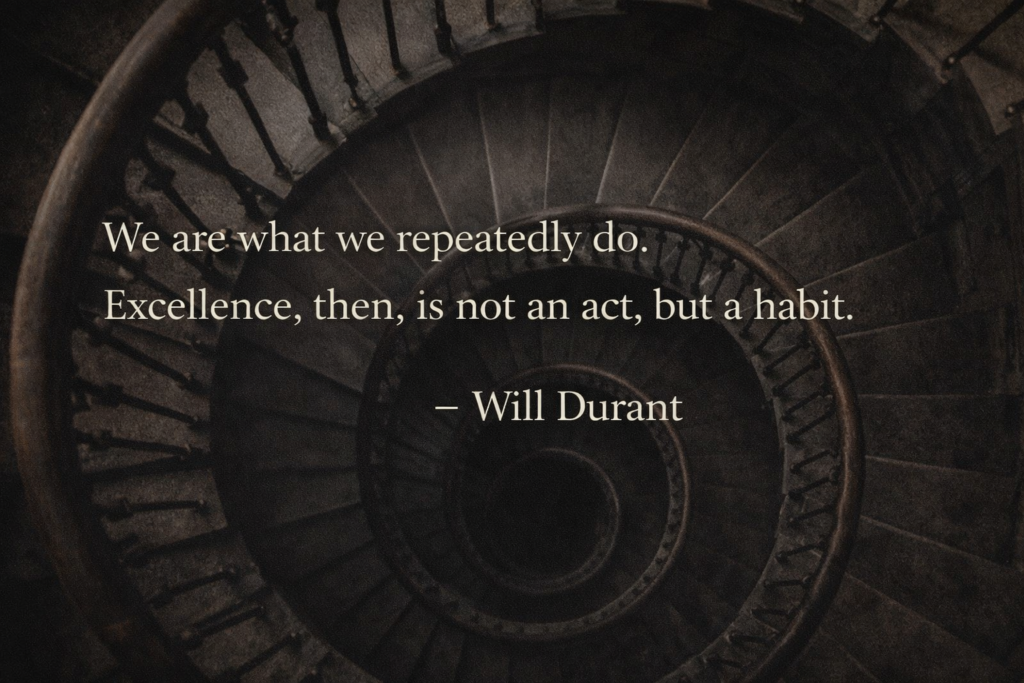
Build Forward
You cannot change what happened. You cannot fully predict what’s coming. But you can decide what kind of man you are today. That decision does not require certainty. It requires consistency. If you string enough disciplined days together, tomorrow begins to organize itself. Not because life becomes easy. But because you become steady.
Steadiness reduces panic. Steadiness clarifies decisions. Steadiness builds trust — with yourself and with others. Yesterday taught you. Tomorrow will test you. Today builds you. And that is enough.
Recommended Reading
If the ideas in this article resonated with you, the following books explore the science and practice of disciplined behavior in greater depth.
Atomic Habits - James Clear
James Clear’s Atomic Habits explores how small daily actions shape identity and long-term outcomes. The book explains how habits form, why they persist, and how small improvements compound over time. Rather than focusing on motivation, Clear shows how disciplined systems and repeatable behaviors create lasting change.
For readers interested in building consistency in their daily actions, this book provides a clear and practical framework for turning intention into execution.
The Brain That Changes Itself - Norman Doidge
Norman Doidge’s The Brain That Changes Itself explores the science of neuroplasticity – the brain’s ability to reorganize itself through experience and repetition. Through real clinical case studies and neuroscience research, the book shows how repeated behaviors literally reshape neural pathways.
For readers interested in the science behind discipline, habit formation, and behavioral change, this book offers a fascinating look at how the brain adapts to what we practice most often.