
the wake-up call
I remember the day I stepped on the scale and couldn’t believe the number staring back at me. I honestly thought something had to be wrong with it, so I stepped off, made sure it was reset to zero, and tried again.
248 pounds.
At 6’1”, it wasn’t catastrophic, but to me it felt like a wake-up call. I stood there asking myself a simple question: How did I get here? Somewhere along the way, I had developed what I jokingly called “Dunlap Disease.” My stomach had done lapped over my belt.
Humor aside, the reality hit me harder than I expected. I knew something had to change if I wanted to feel confident, healthy, and comfortable in my own skin again. The truth is, I didn’t look terrible. But I also realized that untucking my shirt had slowly become less of a fashion choice and more of a cover-up. And if I was being honest, the weight wasn’t the real problem anyway.
The real problem was what it represented: neglect, inconsistency, comfort, and slowly drifting away from the person I wanted to become. That moment forced me to confront something I had avoided for a long time: if I wanted my life to become different, I had to become different first.
For years, I said I wanted my life to change while refusing to change anything about myself or the way I was living. I chased the wrong things, avoided the hard truths, and invested almost nothing into building a better way of life.
I had to take inventory of everything — my habits, mindset, environment, strengths, weaknesses, excuses, distractions, and the decisions that were moving me further away from the life I claimed I wanted.
That realization became the foundation for everything that followed. Because the greatest investment you will ever make is not into a stock, business, or opportunity. It is into yourself.

The hardest part about that realization was understanding that I had spent years waiting for my life to improve while continuing to live in ways that guaranteed it wouldn’t. I wanted better results while protecting the same habits. I wanted more confidence without discomfort. I wanted growth without sacrifice.
And the truth is, most people live this way for far longer than they realize. We convince ourselves we are “trying.” We talk about our goals. We think about the life we want. But thinking is not investing. Wanting change and creating change are two completely different things.
For years, I confused thinking about change with actually creating it. I would analyze my life endlessly, think about goals, talk about plans, and imagine different futures. But thinking is not investing. Investing requires action. It requires sacrifice, consistency, discomfort, and repeated decisions that move your life forward even when you do not immediately see results.
That realization naturally led me to another uncomfortable truth:
Most people never truly invest in themselves.
Why Most People Never Truly Invest in Themselves
Most people say they want a better life. Better health. More confidence. More money. Better relationships. More peace. More purpose. But wanting something and building something are two very different things.
The truth is, most people are not destroyed by one catastrophic decision. They slowly drift. A little less discipline. A little more comfort. A little more distraction. A little less effort. A little more avoidance. Over time, those small choices compound into a completely different life. Nobody wakes up one morning completely disconnected from the life they wanted.
Drift happens gradually. One compromise at a time. One excuse at a time. One ignored standard at a time. Until eventually you look around and barely recognize the direction your life is heading.
One of the biggest lies we tell ourselves is that we will eventually change “when the time is right.” When work slows down. When stress goes away. When motivation returns. When life becomes easier. But life rarely slows down on its own. And motivation is one of the least reliable forces you can build your future around.
What I have noticed in my own life was that things would start to change. They would get better. I would start making more money, begin accomplishing some of the things I said I wanted, and slowly start feeling like I was getting my life together.
And then I would make the same mistake over and over again. I would start choosing comfort over progress. I would get complacent. I would tell myself, “Alright, I got this now,” and little by little my standards would begin slipping. The discipline would fade. The structure would disappear. The urgency would weaken. And before long, right back down the slide I would go.
That cycle always led me to the same place: frustration, disappointment, self-inflicted wounds, and the painful realization that my inconsistency was keeping me trapped in the same patterns.
Modern life offers endless ways to escape yourself. Entertainment. Scrolling. Substances. Constant stimulation. Endless distractions. It has never been easier to avoid uncomfortable truths. But avoidance delays growth. And eventually, the life you avoid building becomes the life you are forced to live.
At some point, you have to stop analyzing your life and begin building it. Most people are waiting to feel inspired before they act. The people who actually change their lives learn to act before they feel ready. That is where self-investment begins.
Not with motivation. With ownership.
Physical Health Changes Everything
One of the biggest mistakes people make is treating physical health like vanity instead of foundation.
Your physical condition impacts nearly every area of your life — your energy, focus, confidence, mood, discipline, stress levels, and ability to think clearly.
When your health declines, everything becomes harder. You become more tired, more reactive, more distracted, and less disciplined. Slowly, you begin accepting lower standards for yourself.
The dangerous part is that decline rarely feels dramatic while it is happening.
It happens slowly.
You become a little more tired, a little less disciplined, and a little more willing to skip workouts, eat poorly, stay up late, and make excuses for yourself. Eventually, things that once would have bothered you begin feeling normal.
Lower standards become accepted standards.
I think many people underestimate how connected physical and mental health really are.
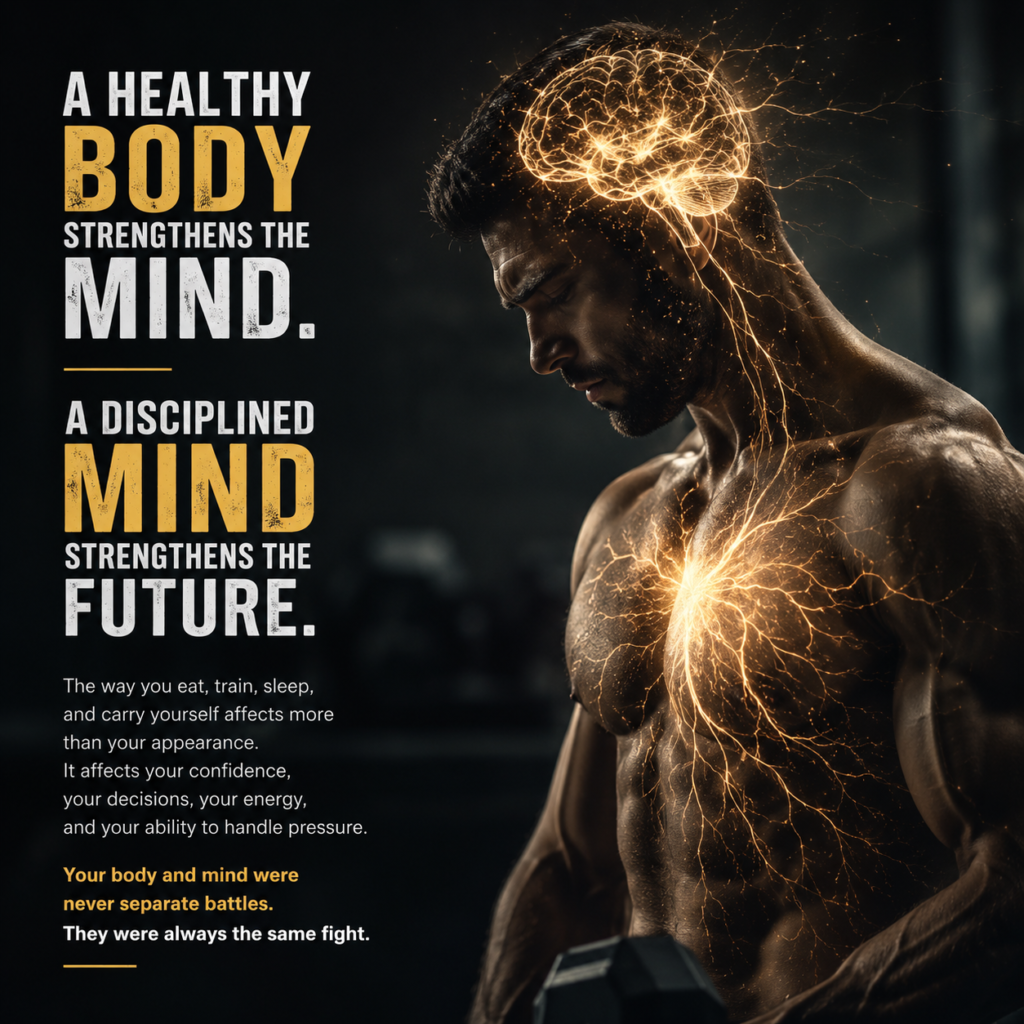
Research continues to reinforce the strong connection between physical exercise and cognitive performance, emotional regulation, memory, focus, and overall mental well-being. The body and mind are not operating independently from one another. Improving physical health often improves mental performance as well.
Numerous peer-reviewed studies have shown that regular physical activity can improve brain function, reduce symptoms of anxiety and depression, enhance memory retention, and increase overall cognitive performance. In many ways, movement is not just physical maintenance. It is mental maintenance as well.
A person sleeping four or five hours a night, living off caffeine, processed food, stress, and constant stimulation is not operating anywhere near their potential. Then they wonder why they feel unmotivated, struggle to focus, feel emotionally exhausted, or cannot stay disciplined. The body keeps score whether we want it to or not.
Research on sleep deprivation consistently shows significant impacts on emotional regulation, cognitive performance, reaction time, stress management, decision-making, and overall physical health. Many people normalize exhaustion without realizing how severely it affects the quality of their thinking, productivity, emotional stability, and daily performance.
Many people believe they lack discipline or motivation when in reality they are mentally and physically depleted from lifestyles that never allow proper recovery. Sleep is not laziness. Recovery is part of performance.
Modern life has normalized exhaustion. People brag about running on caffeine, stress, and four hours of sleep as if burnout is a badge of honor. But eventually the body collects payment for every corner we continue cutting.
One thing I noticed in my own journey was that as my fitness improved, the quality of my sleep improved as well. Not only was I sleeping better, but I actually needed less sleep to feel rested and functional. My energy levels became more stable. My mornings became easier. My mind felt clearer. I was no longer waking up exhausted before the day had even started.
That alone changed more areas of my life than I expected. Better energy improved my productivity. Better sleep improved my mood. Better discipline improved my confidence. Over time, those small improvements started compounding into a completely different quality of life.
I am not saying everyone needs to become a bodybuilder or fitness influencer. But I am saying this: You cannot expect high performance from a system you refuse to maintain. That was one of the foundational ideas behind How to Keep Your Engine Running Smoothly.
Just like an engine eventually breaks down without maintenance, the body and mind eventually begin showing signs of neglect when they are constantly overworked, overstimulated, and under-recovered.
Sometimes investing in yourself starts with simple things:
- walking daily
- drinking more water
- getting enough sleep
- lifting weights consistently
- reducing processed foods
- spending less time sitting still
Small improvements create momentum. And momentum changes identity. Every workout completed, every healthy decision made, and every promise kept to yourself quietly reinforces something important: “I am someone worth investing in.”
The first time you begin keeping promises to yourself again, something shifts internally. You start trusting yourself. And that changes everything. Investing in yourself physically is not about becoming perfect.
It is about refusing to slowly abandon yourself.
Because when your body becomes stronger, your mind often follows. And when you begin proving to yourself that you can stay consistent, you stop seeing yourself as someone who is stuck.
You begin seeing yourself as someone capable of change.
“If you want to dive deeper into metabolism, energy, recovery, and the connection between physical and mental performance, I explore these concepts extensively in How to Keep Your Engine Running Smoothly: The Secret Science of Metabolism.”
Discipline vs. motivation
Motivation feels powerful in the moment. The problem is that motivation fades. Discipline is what carries you when motivation disappears.
Most people wait until they “feel like it.” I do not know about you, but I rarely feel like doing leg day at 5 AM. But I also know I do not skip it because I understand how important it is to both my physical and mental well-being.
Successful people learn to move regardless of how they feel. That does not mean they are emotionless. It means they understand something important: feelings are temporary, but standards are intentional.
People who live entirely by emotion often live inconsistently. They move when they feel inspired and stop when discomfort appears. Structure allows you to continue moving even when emotions fluctuate.
There were many mornings I did not want to get up, many workouts I did not feel like doing, and many days I wanted to avoid responsibility and drift back into comfort. But every time you continue anyway, you strengthen something deeper than motivation.
You strengthen character.
Investing in Your Mind
The quality of your thinking shapes the quality of your life. That is why reading, learning, and developing critical thinking skills matter so much. A person who cannot think clearly will struggle to live clearly.
One thing I began realizing as I started rebuilding my life was how much of my thinking had been shaped by distraction, negativity, emotional reactions, and mental clutter.
Most people consume information constantly but rarely consume information intentionally. We scroll endlessly, absorb opinions, and entertain ourselves for hours, but very few people consistently sit down and intentionally feed their minds something that helps them grow.

Reading changed that for me.
Books forced me to slow down, think deeper, challenge my assumptions, and learn from people who had already achieved what I wanted to understand. Over time, learning changes perspective.
One of the greatest advantages of reading and learning from people who have already been where you want to go is not that they give you an exact blueprint for your life. Your path still has to become your own.
But they can often warn you what not to do. They can help you avoid unnecessary mistakes, wasted years, poor habits, and destructive patterns that only become obvious after experience.
Perspective changes decisions.
And decisions change lives.
The people who continue growing throughout life are almost always obsessive learners — not because they know everything, but because they understand they never will.
Environment Shapes Identity
Who you surround yourself with says more about your standards than it does about their character.
The people you allow close to your life influence your mindset, habits, discipline, and direction. Eventually, the environments you tolerate become the life you live.
That applies to:
- friendships
- relationships
- work environments
- online content
- habits
- routines
- conversations
Everything around you is shaping you whether you realize it or not.
If you constantly surround yourself with negativity, excuses, gossip, laziness, and distraction, eventually those things begin feeling normal.
On the other hand, when you spend time around disciplined, growth-oriented, intentional people, your standards begin rising naturally.
Environment matters more than most people realize.
Sometimes investing in yourself means changing the rooms you continue walking into.
There were periods in my life where I kept surrounding myself with environments that reinforced comfort instead of growth. I stayed connected to habits, routines, and influences that made stagnation feel normal.
The difficult truth is that growth often requires separation.
Not because you believe you are better than other people, but because you finally recognize that not every environment is helping you become the person you are trying to build.
Some people will support your growth.
Others will become uncomfortable the moment your standards begin changing.
That is part of the process.
The people closest to you will often reveal whether they are connected to your comfort or connected to your growth.
And sometimes investing in yourself means being willing to disappoint the version of yourself that wanted to stay comfortable.
Because environments do not just influence behavior.
Over time, they influence identity.
The Life You Build
Investing in yourself is not selfish.
In fact, it is one of the most selfless things you can do for the people you love.
The healthier, stronger, wiser, more disciplined, and more emotionally stable you become, the more capable you are of showing up for others. You increase your chances of living longer and living better. You create more opportunities to build a better life not only for yourself, but for the people you care about most.
Whether you realize it or not, your future is being built by the choices you make every single day — the foods you eat, the thoughts you entertain, the habits you repeat, the people you surround yourself with, and the standards you tolerate.
Every decision is either building your future or quietly pulling you away from it.
The good news is this:
No matter how far you feel you have drifted, you can begin rebuilding.
One decision, one habit, and one promise kept to yourself at a time.
Because the greatest investment you will ever make is not into a stock, business, or opportunity.
It is into the person responsible for carrying your entire future.
Continue the Journey
Investing in yourself is not a one-time decision. It is a commitment you make each day through the choices you make, the habits you build, and the standards you refuse to compromise.
If you found value in this article, I invite you to join the Tayls of Truth community.
Subscribers receive new articles, practical tools, personal development resources, and insights focused on physical, mental, emotional, financial, and spiritual growth.
The goal is simple: help you become the strongest version of yourself and build a life you can be proud of.
Enter your email below and join us as we continue the journey.
Newsletter
If these reflections help you think more clearly, you can subscribe here.
I send occasional notes on discipline, health, and rebuilding — no noise.
Thank you!
You have successfully joined our subscriber list.