
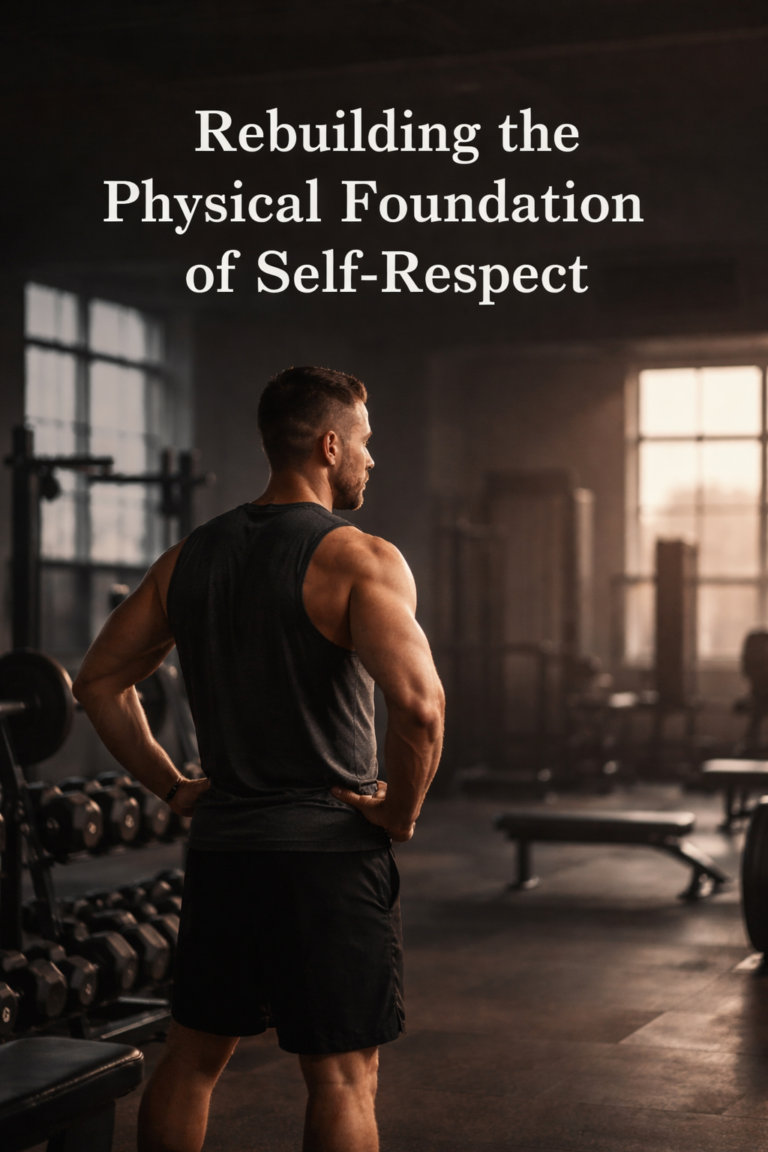
Rebuilding the Physical Foundation of Self-Respect
Most men don’t wake up one morning and decide to let their health fall apart.
It happens slowly. Quietly.
A little less energy in the mornings.
Sleep that no longer feels restorative.
Clothes that fit differently — but not dramatically enough to trigger concern.
You still function.
You still show up.
So you tell yourself it’s fine.
Age. Stress. Work. Life.
But over time, something shifts beneath the surface. You don’t feel as sharp. Your patience shortens. Your confidence dulls. And even if you can’t articulate it clearly, you know something is off.
For most men, the body is the first place that disconnect shows up.
The Moment I Couldn’t Ignore
I wrote a piece once called Wake-Up at 248, and I remember that day with uncomfortable clarity. I stepped on the scale, saw the number staring back at me, and genuinely thought it had to be wrong.
I didn’t have a massive belly.
I wasn’t completely out of shape.
I didn’t look like what I imagined “248 pounds” was supposed to look like.
That moment forced a realization I had been avoiding for years: this wasn’t just about appearance. It was about how I felt in my body — and more importantly, how I felt about myself.
Somewhere along the way, my self-image no longer matched my reality.
That gap does damage.
When your body feels unreliable, sluggish, or out of your control, it quietly erodes your sense of self-trust. You hesitate more. You avoid certain situations. You shrink just enough that you notice — but not enough to take immediate action.
I carried that tension longer than I should have.
Rebuilding Momentum
I’m proud to say I’m now down to 200 pounds — close to where I want to be. Not just in terms of how I look, but in how I move through the day.
My energy is steadier.
My sleep is deeper.
My mood is more consistent.
There’s a quiet, grounding satisfaction that comes from setting goals and following through on them.
At the gym, I’ll occasionally catch a younger woman glancing my way. I won’t pretend that doesn’t feel good. I’ll never be a fitness model — and I don’t want to be — but I do want to be a man whose partner is happy with what she sees when she looks at me.
More than that, I want to be comfortable in my own skin again.
Why Physical Health and Self-Esteem Are Linked
What this process taught me is something most men are never explicitly told:
Physical health and self-esteem are inseparable.
When your body is neglected, confidence doesn’t just drop — it becomes conditional. You feel better only when circumstances align. When you’re rested. When work is light. When stress is low.
But the moment pressure returns, that fragile confidence collapses.
This isn’t vanity.
It’s physiology and psychology working together.
Research has consistently shown that regular resistance training improves psychological well-being, self-esteem, and mood in men when practiced with consistency over time.
When you regain control of your physical foundation, subtle things begin to change.
Your posture shifts.
Your presence steadies.
Your internal dialogue quiets.
You don’t just look different.
You carry yourself differently.

Why Routine Matters More Than Motivation
The real shift didn’t come from motivation.
Motivation is unreliable.
It comes and goes.
It fades the moment stress rises or life gets heavy.
What changed everything was routine.
I don’t miss gym days. Even when I don’t feel like going — especially then. Those days often become my best workouts, not because they’re intense, but because they reinforce something deeper:
A Deeper Framework for Keeping the Engine Running
Everything I’ve shared here — routine over motivation, physical health as a foundation, consistency as identity — is the result of learning the hard way what happens when that foundation is neglected.
That’s why I wrote How to Keep Your Engine Running Smoothly.
The book isn’t about chasing aesthetics or quick fixes. It’s about understanding how the body actually works, how habits compound over time, and how physical health supports every other area of life — energy, focus, discipline, and self-respect.
If this post resonated with you, the book expands on the same ideas with more structure, science, and practical application. It’s meant to help you keep the engine running — not just get it started
I keep promises to myself.
That consistency does more than build muscle.
It builds trust.
It grounds you when other parts of life feel uncertain.
Most men focus their training on what they can see — arms, chest, shoulders. But real strength begins lower than that. The foundation of the body matters more than most people realize.
When it’s neglected, progress stalls — physically, mentally, hormonally.
Support Reinforces Consistency
Once routine is established, support matters.
Not as a shortcut — but as reinforcement.
Most men fail here because they reverse the order. They look for tools before they’ve built structure. When the structure isn’t there, nothing sticks. When it is, the right support compounds progress.
For me, this meant reinforcing discipline from three angles:
Understanding.
Having language and perspective around why consistency matters makes it easier to return when motivation fades.
Framework.
A clear model for how physical health, routine, and long-term alignment work together prevents drifting back into old patterns.
Biological support.
When the body is under-supported — digestion, appetite regulation, recovery — discipline becomes harder than it needs to be. Supporting the system makes consistency more sustainable.
None of these replace effort.
They make effort repeatable.
And repeatability is what actually changes a man over time.
Alignment Over Appearance
Reclaiming physical health isn’t about chasing an image or proving something to others. It’s about restoring alignment between who you are and how you live.
When the body is supported, confidence stops feeling fragile. Discipline sharpens. Decisions become cleaner. Forward progress feels possible again — even when life is demanding.
This work doesn’t require perfection. It requires consistency.
And consistency isn’t built in dramatic moments. It’s built quietly — in routine, in repetition, and in the willingness to show up when motivation is absent.
The physical foundation matters because everything else is built on top of it.
When it’s solid, you don’t have to force confidence.
You don’t have to chase discipline.
You don’t have to negotiate with yourself as often.
It starts the same way it always does.
By showing up — again, and again, and again.
Recommended Reading for Sustainable Progress
One book that reinforced this shift for me wasAtomic Habits by James Clear.
It isn’t a fitness book in the traditional sense. It’s a framework for understanding how small, repeated actions shape identity over time — which is exactly what sustainable physical progress requires.
The book helped solidify something I had already begun to experience firsthand:
consistency isn’t about motivation. It’s about building systems that make showing up inevitable.
If you’re trying to rebuild your physical foundation and keep your engine running long term, this book is a solid place to start.